Boart Longyear

Exploration / Tooling / Bits

Longyear

A HISTORY OF INNOVATION

Our diamond products were originally developed by Anglo American Corporation in the 1930s as a way to commercialize industrial-grade diamonds for the world’s leading diamond producer. Boart Products led the research and development program which enabled practical and reliable manufacturing of diamond coring bits.

As we entered our ninth decade, our engineers in North Bay, Ontario secured a reliable source of high-performance synthetic diamonds which triggered the development of a completely revolutionary bit design – the impregnated-diamond bit. With decades of powder metallurgy experience behind them, Longyear engineers set out to develop a new crown which consisted of synthetic diamonds evenly distributed throughout a composite matrix. This new design could drill further and faster than surface-set bits and it cut through much harder material. By 1980, 75% of our Canadian-produced bits were of the new impregnated type and Longyear was manufacturing diamond bits in more than eight countries.

Today, there are many marketers of diamond bits and very few of those companies have invested in bit development. Boart Longyear is dedicated to the development of diamond bit technology. You can see it in our designs, such as the patented Stage®, Razorcut® and Longyear® innovations. You can trust us to deliver continued innovation.

RAZORCUT™

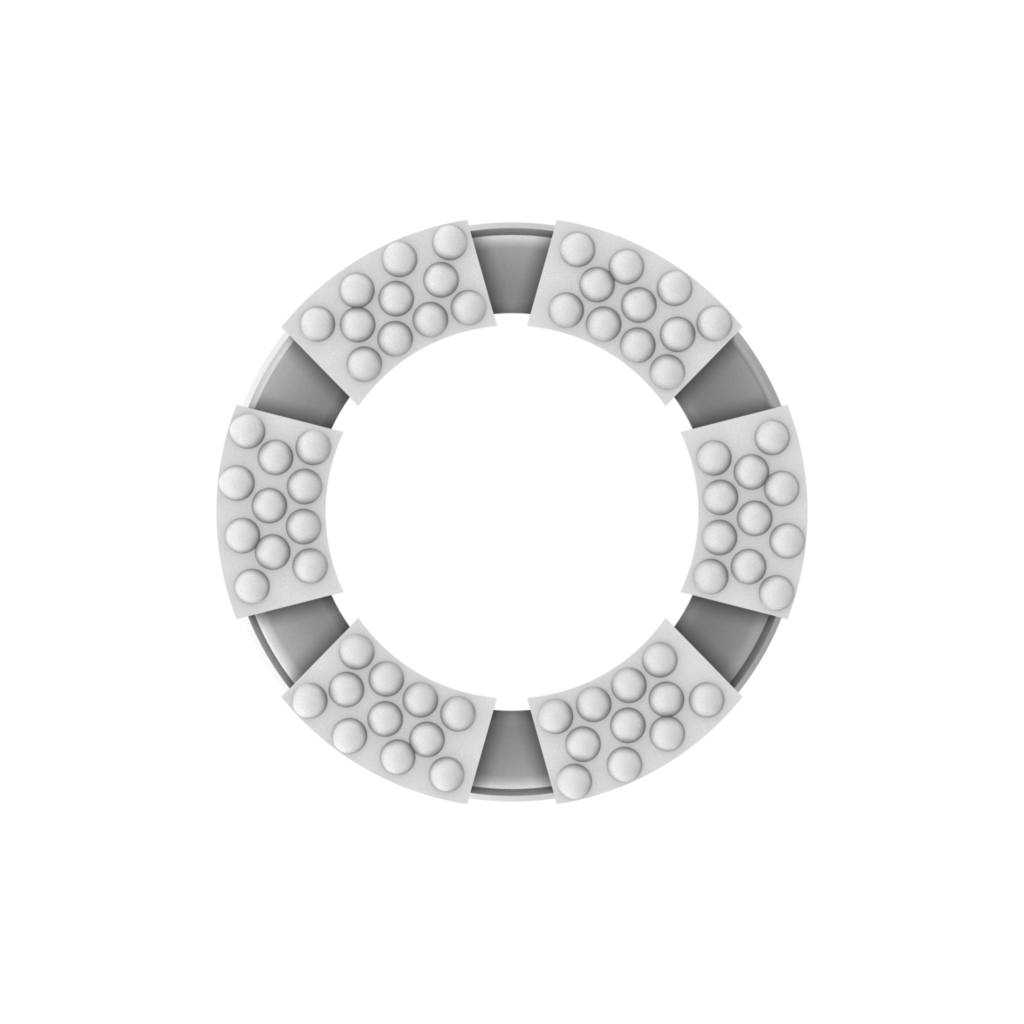
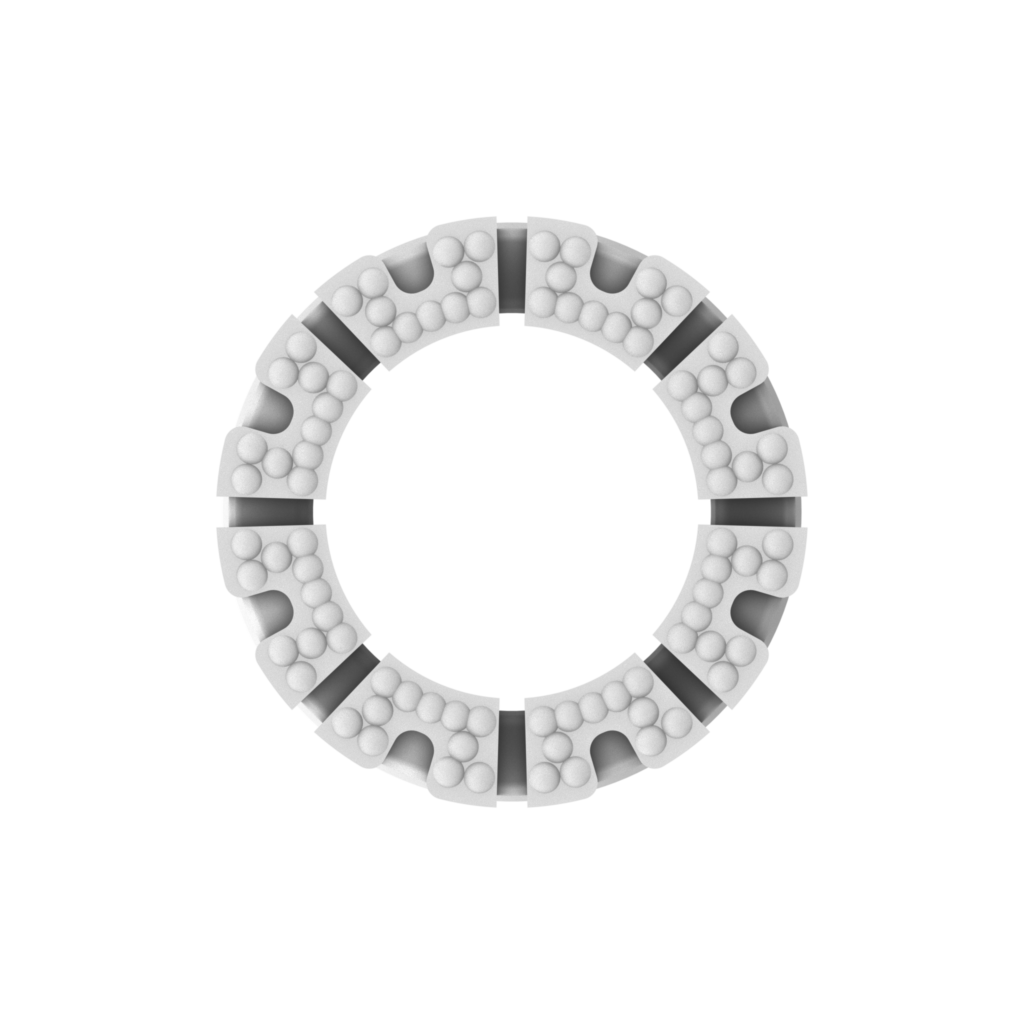
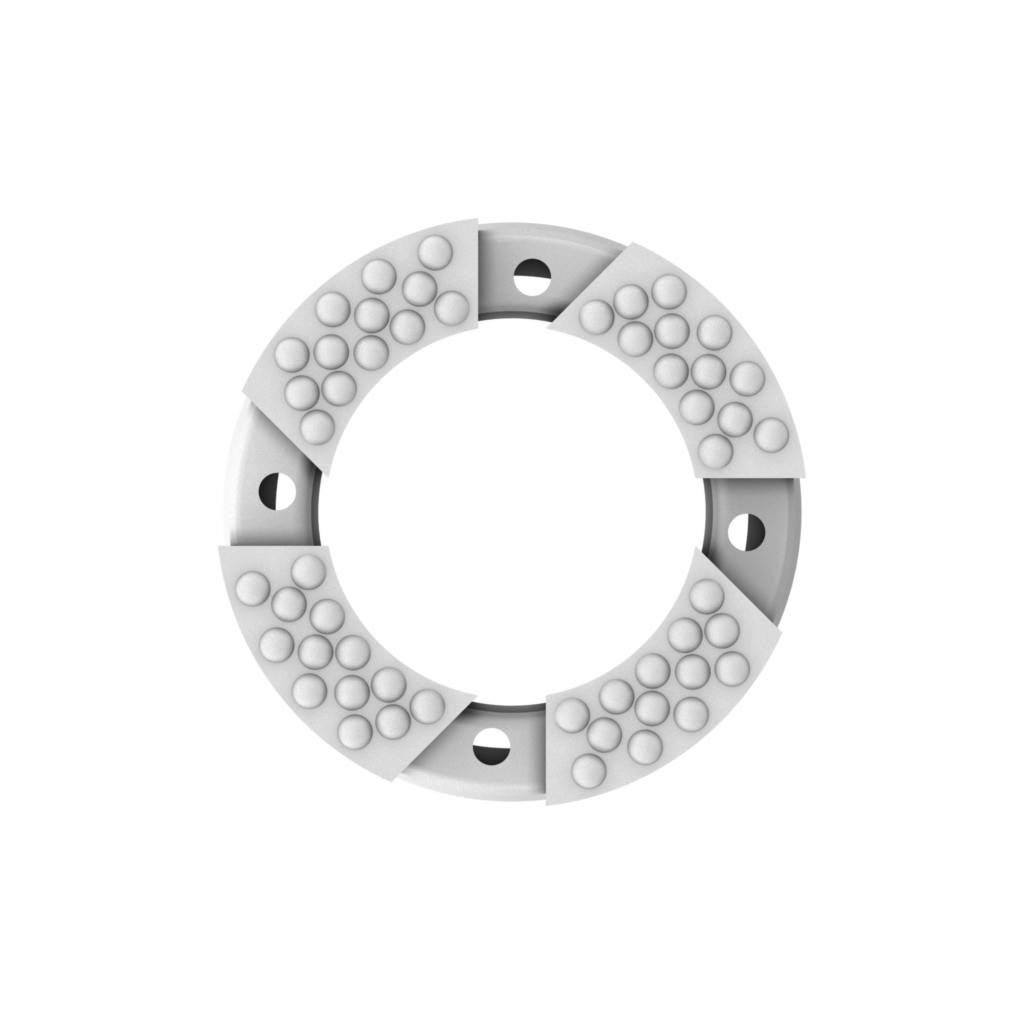
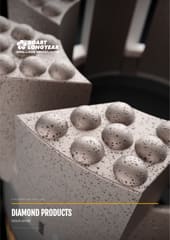
Boart Longyear’s patented Razorcut™ protrusions on the bit’s face contain diamonds that enable the bit to begin cutting right out of the box, even in the softest ground. The arrangement of these protrusions also improves the tracking and balance in the hole when drilling begins.

INNOVATIVE WATERWAY GEOMETRY

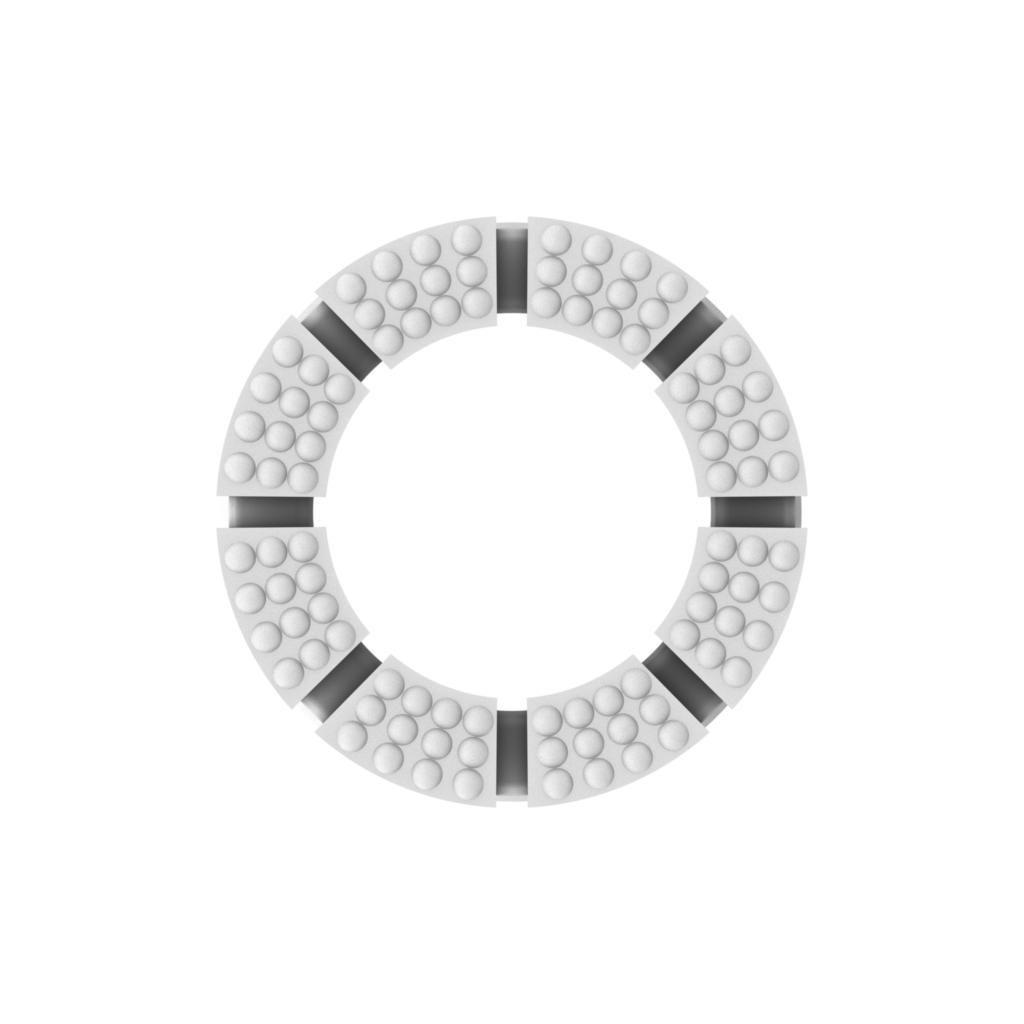
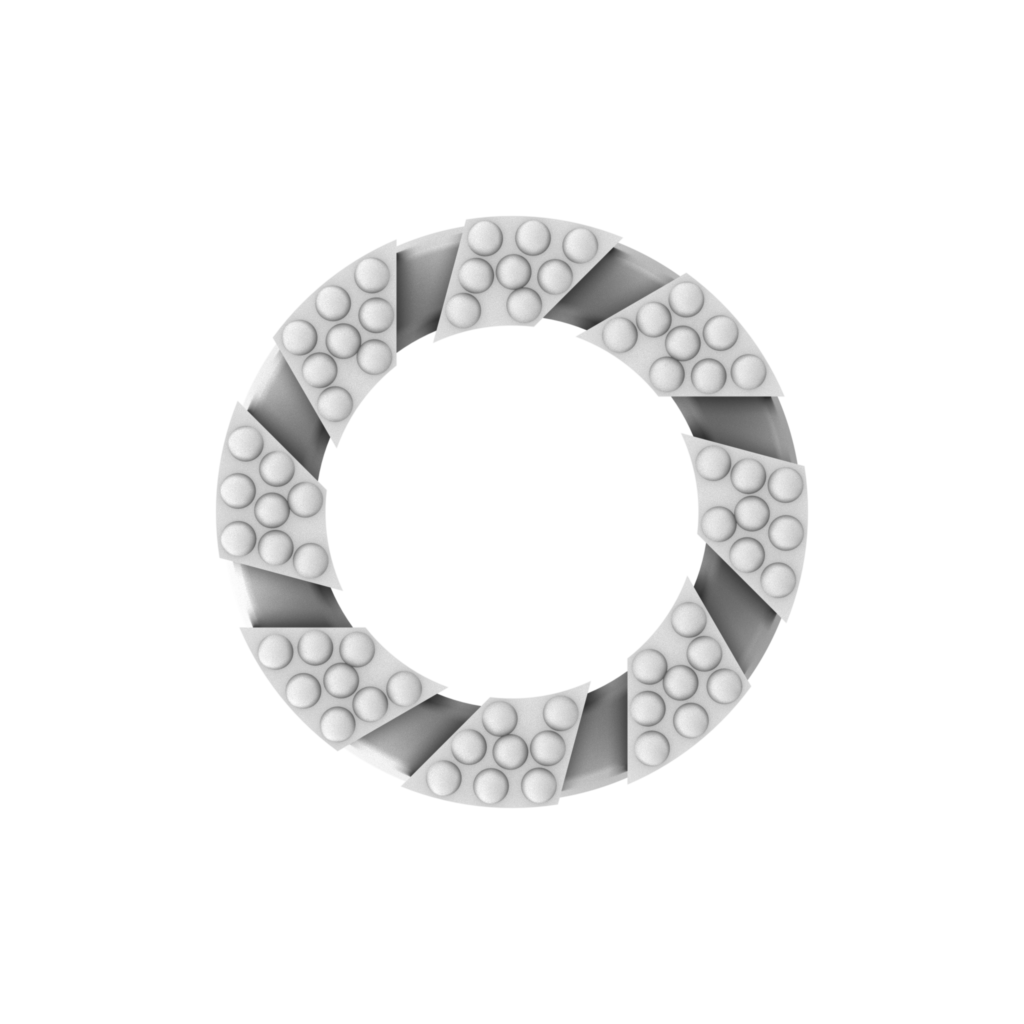
Our newest geometry, the tapered swirl (TSW), offers fast penetration in competent ground with the added ability to easily push cuttings in broken ground conditions to the OD thanks to the tapered design. This geometry is currently available in 20mm crown heights for extended life. 

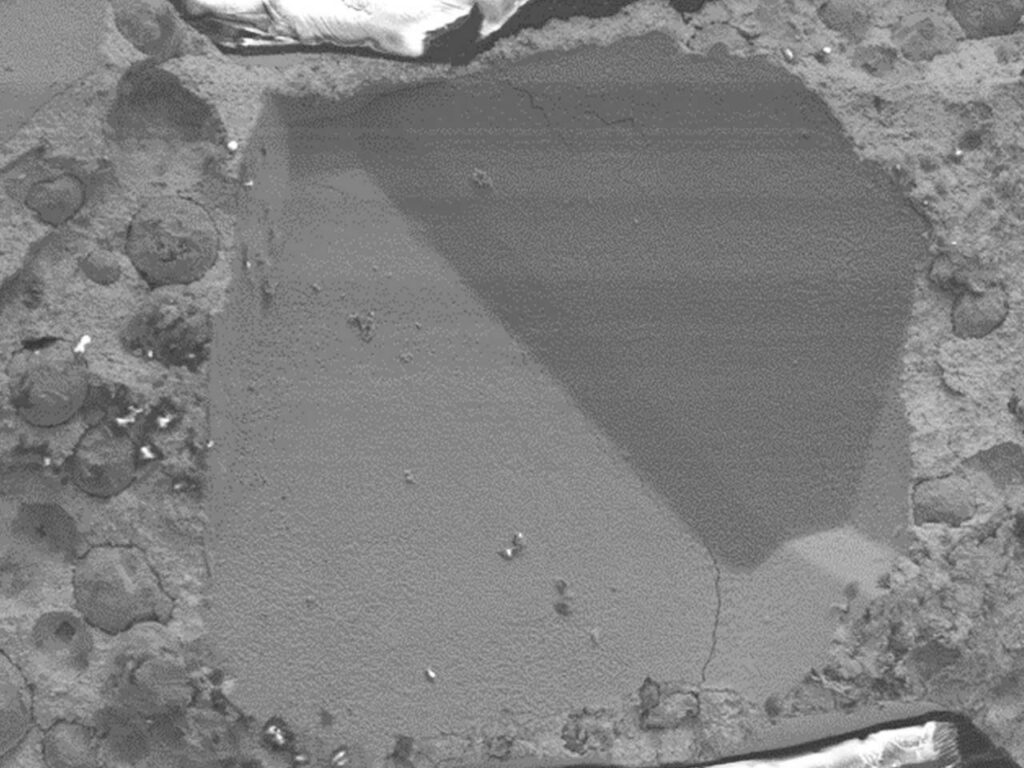
Above: gap in mechanically bonded diamond

LONGYEAR™ MATRIX

Boart Longyear successfully created a chemical bond between diamond and matrix, which acts stronger than the diamond itself. Thanks to this chemical bond, diamonds can project farther above the matrix, allowing for longer life, higher penetration rates, and improved face flushing with the easy, smooth drilling characteristics that drillers prefer. This means increased productivity throughout the entire operation.

By developing a proprietary process of coating diamond bits while in the furnace, Boart Longyear has successfully created a chemical bond between diamond and matrix. The bond is stronger than the diamond itself and provides higher diamond projection (up to 80% compared to 40% for mechanical bonding), improving flushing, penetration rates, and bit life.

Typical diamond coatings do not form chemical bonds due to the strong oxide layer on typical titanium coatings, resulting in the same 40% diamond projection as with mechanical bonding. As a Longyear bit drills and the matrix wears down around the bottom, the diamond stays in place longer and acts like a larger diamond, resulting in more meters per bit.

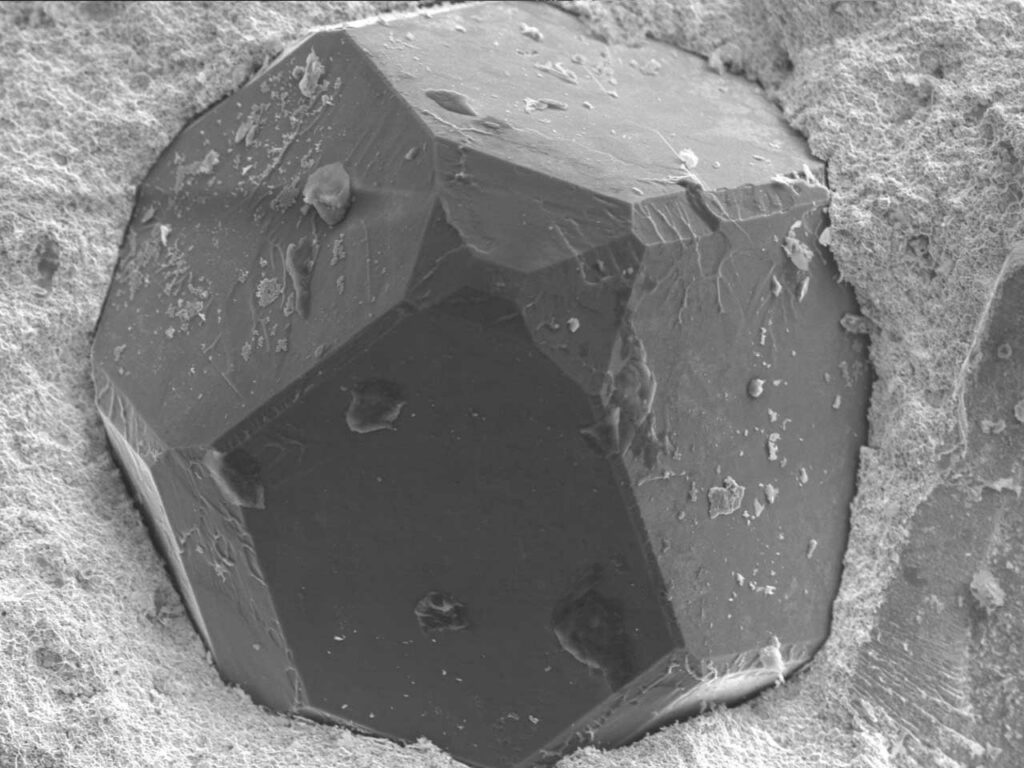
Above: no gap in Longyear™ Diamond Bit matrix

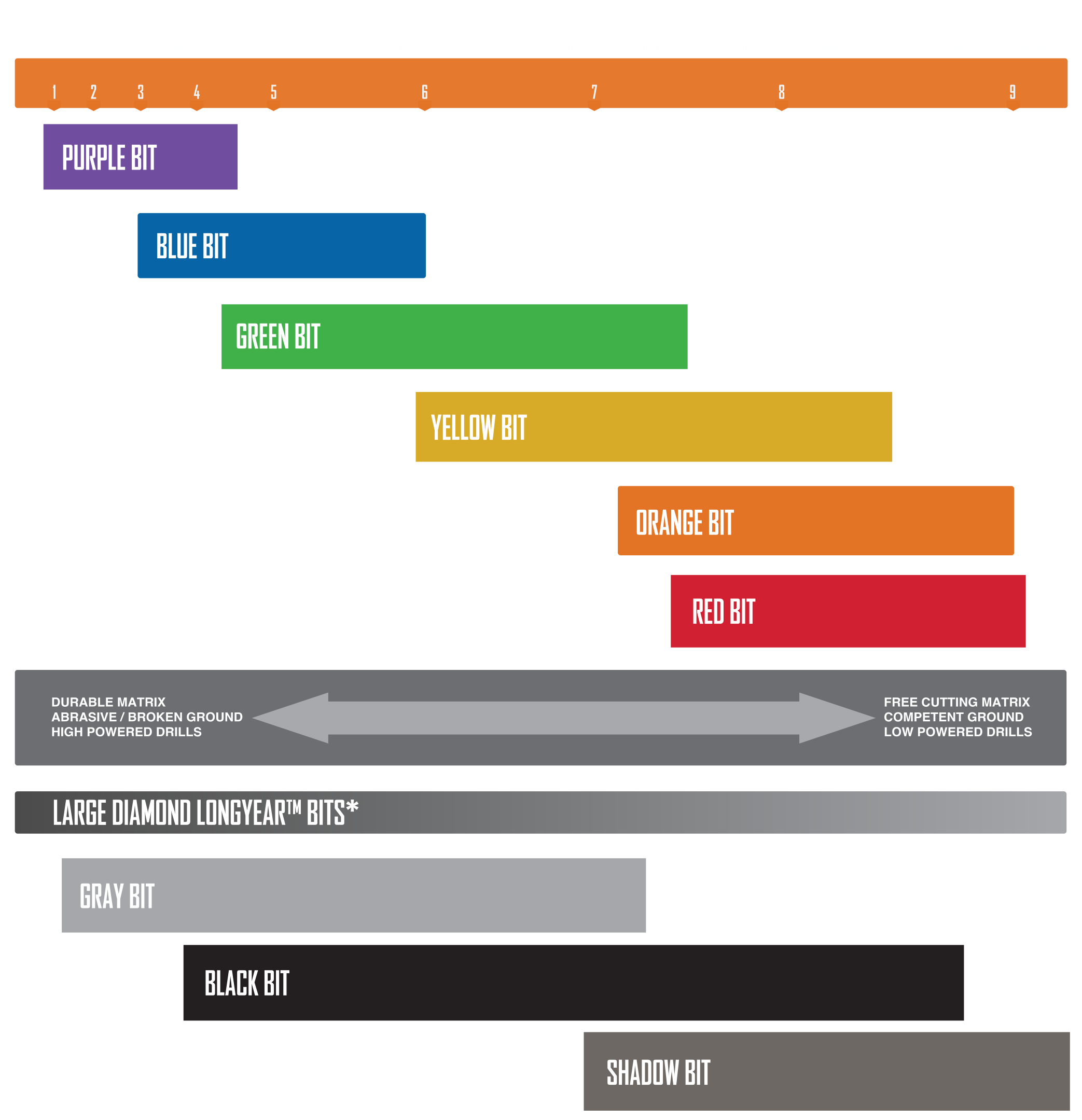
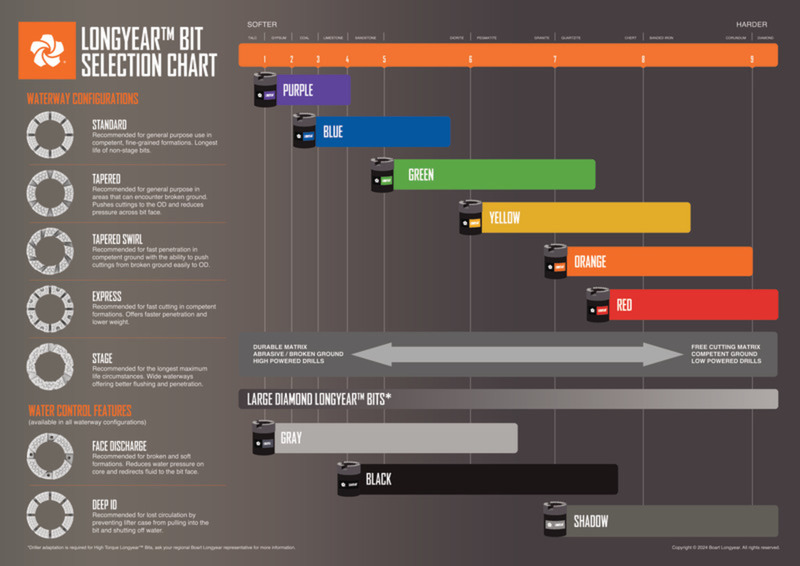
Boart Longyear · Impregnated Diamond Exploration Bits · Data sourced from Boart Longyear Bits Guide 2023

This tool provides initial guidance only. Always confirm selections with your Boart Longyear representative.

Standard (STD)

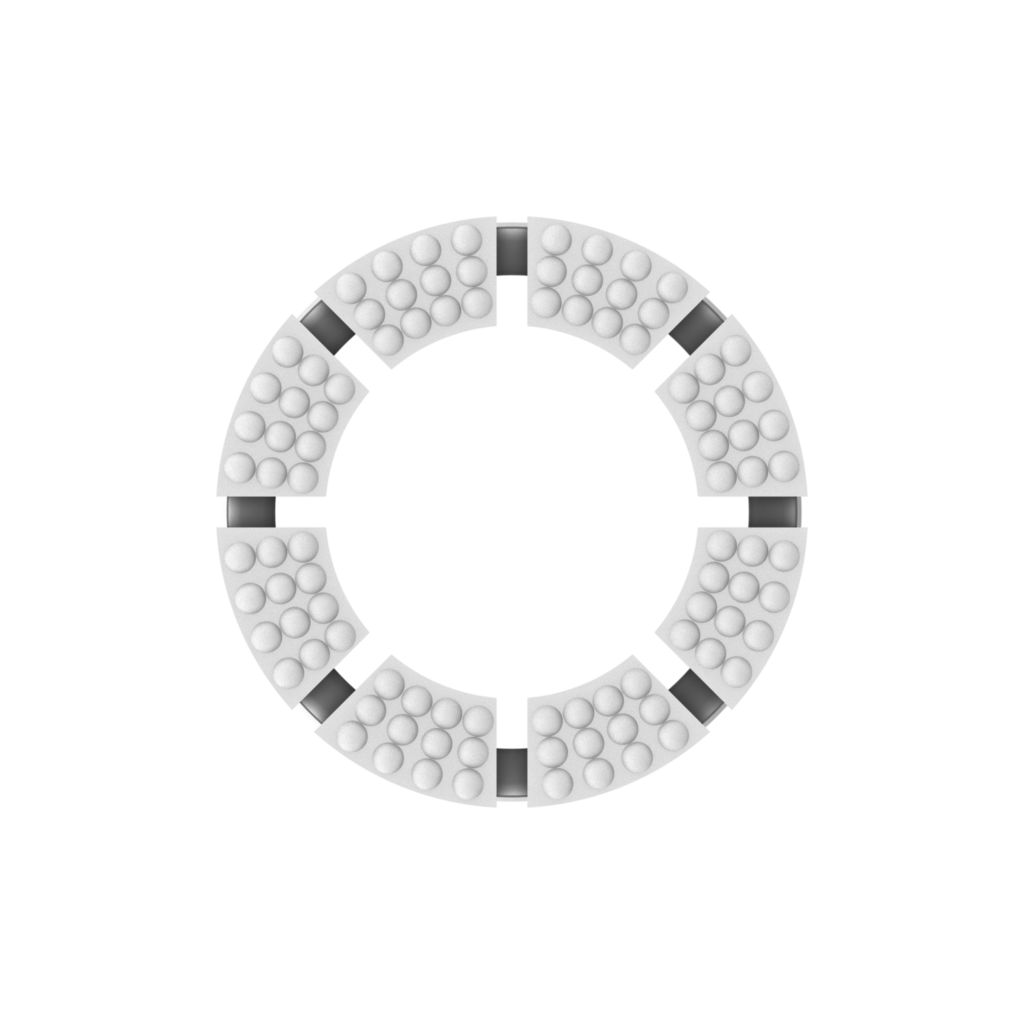
Recommended for general-purpose use in competent, fine-grained formations.

Tapered (TW)

Recommended for general purposes in areas that can encounter broken ground. Pushes cuttings to the OD and reduces pressure across the bit face.

Tapered Swirl (TSW)

Recommended for fast penetration in competent ground with the ability to push cuttings from broken ground easily to OD.

Express (EX)

Recommended for fast penetration in competent formations.

STAGE and GT (STG, GT)

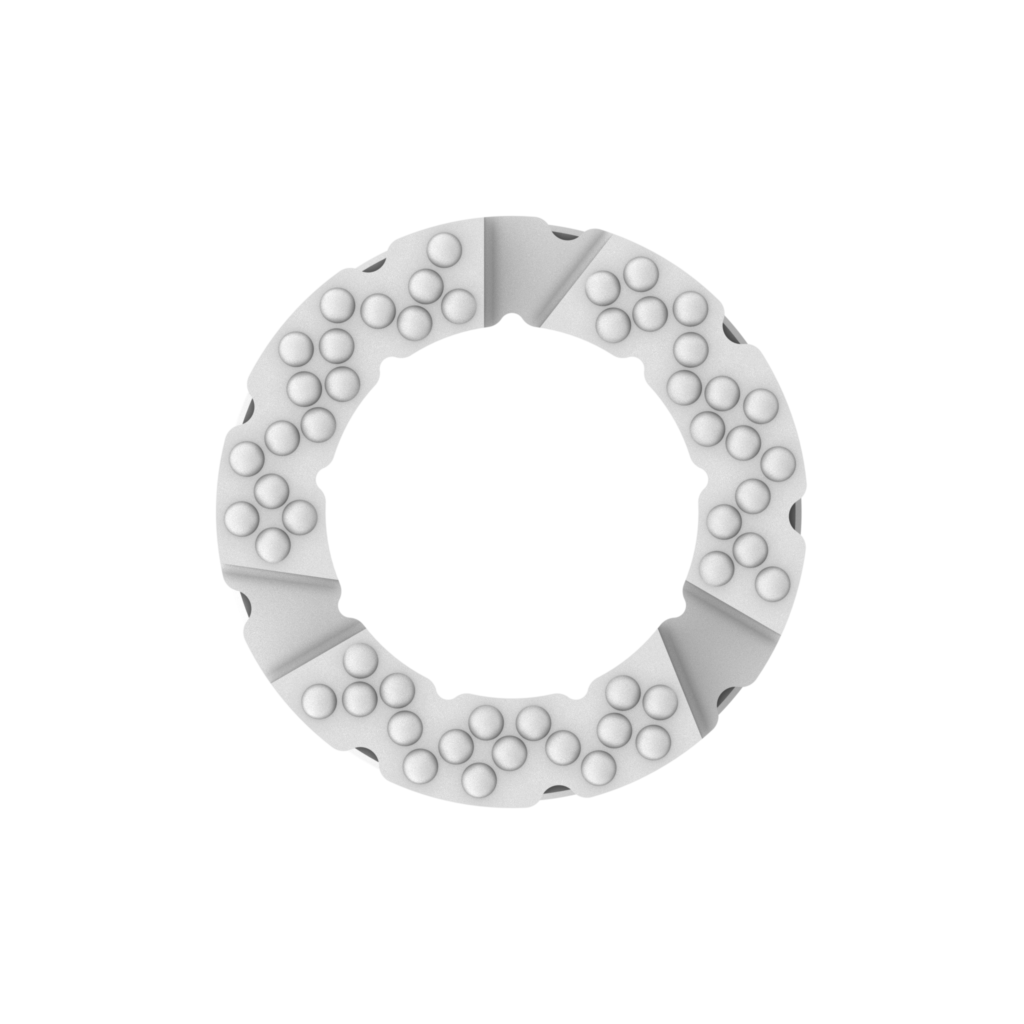
Recommended for maximum life. Wide waterways improve flushing of cuttings from the bit face.

Deep ID (DD)

Recommended for lost circulation by preventing the lifter case from pulling into the bit and shutting off water.

Face Discharge (FD)

Recommended for broken and soft formations. Reduces water pressure on the core and redirects fluid to the bit face.