
Infrastructure / Overburden Cased Drilling
Rods and casing
Rods and casing
TWIN DRIVE™
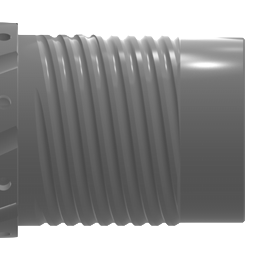
Our patented TWIN DRIVE™ threads have been developed for rotary-percussive casings and inner rods to handle the increased percussive power of hydraulic drifters. A typical cylindrical or conical thread form has a concentration of the clamping stresses at the base of the male thread. The TWIN DRIVE™ thread form distributes the clamping load along the full length resulting in lower stresses at any given point in the thread. This means that it takes much less torque to make and break the rod joint and provides up to 40% additional tooling life in hard ground conditions. TWIN DRIVE™ threads are available on all rotary percussive casing and rods.
Boart Longyear uses the TWIN DRIVE™ thread on all critical threading applications including modular flushing heads, TDN inner rod systems and non-percussive applications such as geothermal and jet grouting tools.
TWIN DRIVE™ threads reduce stress, are easier to uncouple, have a higher loading capacity, are more leak resistant of flushing substances, and offer reduced susceptibility to corrosion.
CYLINDRICAL
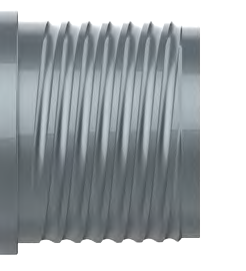
Cylindrical threads are characterized by a parallel wall design which means that the casing or rod must be completely unscrewed prior to separating the joint.
Cylindrical threads are the most common threads utilized for reusable overburden rotary-percussive casing and inner rods. For rotary-percussive casing, all cylindrical threads are singlestart up to 88.9 mm and triple-start for larger diameters.
All standard rotary overburden casing is manufactured by Boart Longyear with a double-start cylindrical thread.
CONICAL
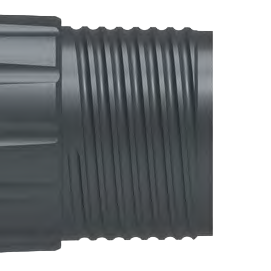
Conical threads are similar in thread form and appearance to cylindrical threads except that there is a 0.5° – 1.0° angle in the thread form giving the thread ends a slight conical shape.
It will require fewer turns to open and separate a conical thread joint due. Conical threads are available only on rotary percussive casing.
THREAD DIRECTION
Casing and inner drill rods are offered in both left and right-hand threads. The required direction of rotation is determined by the drill system and the drilling heads being used.
Typical Direction of Rotation
THREAD STARTS
The number of thread starts on a given thread varies with the size of the tooling, the application of the tooling, and the type of thread.
Thread Starts – Rotary Percussive Rod/Casing
Thread Starts – Rotary Casing
THREAD LENGTH
The thread length of overburden casing varies by casing diameter and thread type.
Thread Length
Rotary Percussive Casing
Friction-welded rotary percussive casings are available in standard sizes with left-hand threads and spanner flats.
- Designed for use in drive drilling and duplex drilling systems
- Engineered to withstand the percussive forces from hydraulic drifters
- Reinforced wall thickness at thread ends to handle heavy percussive drilling
- Superior percussive power transmission due to Twin Drive™ threads
- Highest quality quench and tempered thread ends
- CASINGS ARE FRICTION WELDED UP TO 254 MM.
Rotary Percussive Rod - Twin Drive™ Rod
Twin DriveTM drill rods are designed for use on the inner drill string of duplex and rotary percussive drilling systems.
Twin Drive rods are an alternative to the T38 and T45 extension rods used in these systems. Up-hole flushing velocity may be reduced when using T38 and T45 rods due to the large annulus. Twin Drive systems are designed to minimize the clearance between the inner rod and the casing to optimize up-hole flushing velocity. The larger inner diameter of the inner rod allows a higher medium flow without creating back-pressure, in addition to improved flushing.
Twin Drive rods increase flushing capacity. Twin Drive drill rods (depending on size) can have an inner diameter up to 100% larger than standard percussive T45 and T51 drill rods. Twin Drive drill rods are comprised of special hardened/nitrided alloy steel and special steel mid-bodies.
Twin Drive rods have two percussion surfaces compared to the single surface typically found on standard percussive drill rods. This dual-percussive surface area transmits percussion force through the drill rod at an optimal rate while increasing the drill rod’s strength.
Rotary Casing
All Boart Longyear™ rotary casing is intended for re-usable casing applications where it is removed after grouting. Rotary casings are designed for rotational drilling without percussion. All sizes are available with right-hand or left-hand thread configurations. Rotary casings have a continuous, flush inner diameter throughout their length. Rotary casing is also available with the Twin Drive™ thread. Sizes up to 406 mm diameter are available upon request.
FRICTION WELDED ROTARY CASING
Friction-welded casing has quenched-and-tempered pin and box ends constructed of high-tensile-strength steel. The threaded ends are friction-welded to a mid-body made of an economical mid-grade steel. Casings are friction-welded up to 254 mm. Larger casings are manually welded.
- Economical choice for re-usable casing
- Quench and tempered high-grade rod ends for numerous make and break cycles without damage or galling of threads
- Friction-welded for a superior welded connection between threaded joints and mid-body
DIRECT THREAD ROTARY CASING
Direct thread casing has the pin and box threads machined directly into an annealed mid-grade steel.
- Annealed steel construction for superior tensile strength and resistance to abrasive wear during use
API Drill Rod
API DTH drill rods are designed for use in rotary and rotary DTH applications.
These are commonly used as single rotary rods or as the inner drill string on double-head rotary applications.
The rod ends of API rods are constructed of high-tensile-strength quenched-and-tempered steel. The rod ends are gas nitrided to extend the life of the drill string. Rod ends are friction-welded onto mid-grade mid-body material.
API rods are manufactured in a variety of lengths and wall thicknesses and include internal flush designs for additional flushing capacity. Boart Longyear can manufacture alternative rod lengths and spanner flats upon request.
- Long-life thread designs utilizing high-strength steel
- Friction welding for a superior welded connection between threaded joints and midbody
- Customized length and flats as required
CBXP Drill Rods
CBXP drill rods are primarily intended for use in rotary and rotary DTH drilling applications, but are also commonly used as the inner drill string on double-head rotary-rotary applications or in a single-head rotary duplex application. CBXP may also be used for smaller percussive drilling applications.
The rod ends of our CBXP rods are constructed of high-tensile-strength quenched-and-tempered steel and are gas nitrided to provide additional life. Rod ends are friction-welded onto mid-grade mid-body material.
CBXP rods are manufactured in a variety of lengths and wall thicknesses. Boart Longyear can manufacture alternative rod lengths and spanner flats upon request.
- More robust thread compared to API
- Higher torque capacity compared to API
- Transition from percussive force
- Larger flushing capacity compared to API
- Long-life thread designs with high-strength steel
- Superior welded connection between threaded joints and midbody
- Customized length and flats as required