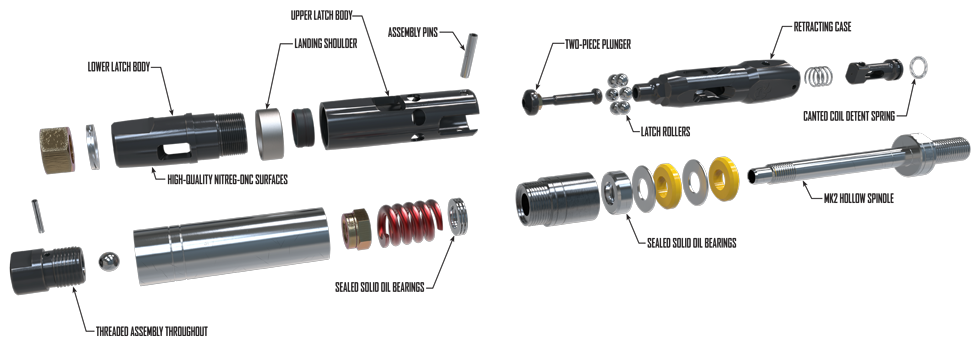
Roller Latch technology produces stronger, more reliable latching, eliminates drive keys and tangs, and latches radially, without swinging, unlike conventional latch mechanisms, preventing stuck tubes.
FREE FLOW DESIGN FOR FASTER DESCENTS
New canted coil spring holds the latches in place for improved latch speed and reliability. Increased piston travel and larger fluid ports greatly reduce fluid drag during descent/retrieval, and provide latch indication.
The hollow spindle has an open fluid cross-section to increase tripping speed, with an inner tube cap in the standard location to allow rod “checking”.The hollow spindle and latch detent allow the Roller Latch head to descend up to 34% faster.
SOLID OIL BEARINGS
These sealed bearings can be installed in any direction and eliminate greasing, making maintenance much simpler, and prevents grease from contaminating the core sample.
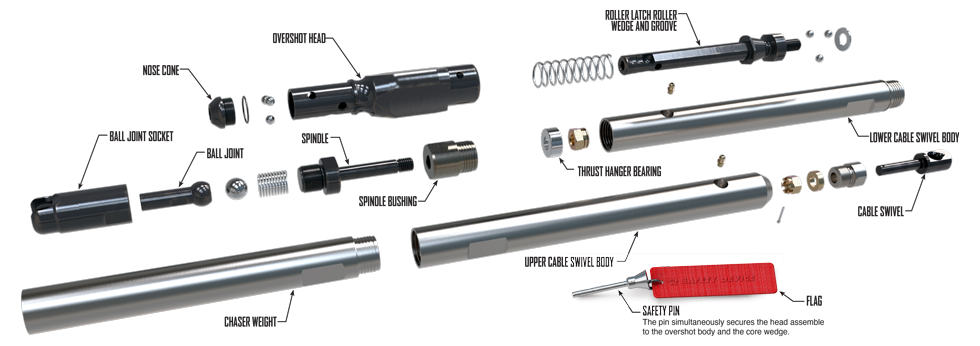
OVERSHOT FEATURES AND FUNCTIONS
The new overshot allows users to eliminate spearheads and lifting dogs entirely. Lifting dogs experience wear on their latching surfaces with every use, as do the spearpoints. Eventually, the surfaces wear, and the connection fails. Our patented Roller Latch design reduces the chance of release due to wear by ensuring rolling engagement and locking.
OPTIMIZED SHAPE
A CFD-optimized shape with lower pressure drag means less water needs to be accelerated to flow around the overshot.The new design results in 20% faster descent speeds than the Ezy-lock Overshot, and 60% faster in W-Wall rods.
SOCKET ADAPTER & SAFETY PIN
Designed to upgrade existing head assemblies, the spearhead is completely replaced by a socket in the head. The safety pin provides a secondary safety device under all conditions and does not degrade with overshot wear.
360º DEGREE SWIVEL
The new Roller Latch pivot design uses past experience to improve the handling of inner tube assemblies. Once out of the rod, inner tube assemblies need to be moved to work areas and laid flat so that the overshot can be disconnected. Having a flexible joint is critical to completing this task safely and quickly.